| President Damiani's Opening Address |
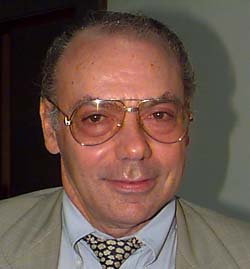 
Monsieur le Président, Your Excellency We are profoundly grateful and honoured to have been given the opportunity to organise the epoch-making IOC Grand Prix bridge event here in the Olympic Museum. At the same time, we are glad to support the idea of the Olympic Museum which is due to your vision and perseverance. We would like to thank you, Monsieur le Président, most sincerely for supporting the launching of this event. We thank also our good friend, Marc Hodler, who kindly introduced the World Bridge Federation - a recognised organisation - and bridge here in the IOC headquarters. We are also thankful to IOC officials led by Mr Gilbert Felli, who extended to us their co-operation. Once again, our sincere thanks and a very warm welcome to you all! We feel privileged to show you what the World Bridge Federation and Bridge are all about, who we are and why we wish to submit our claim to be treated as an international (sports) federation. Following approval of WBF as a recognised Organisation, a certain number of countries have already accepted their national bridge federations into their National Olympic Committee (China, Italy, The Netherlands, etc,). The intrinsic value of the intellectual sport of bridge is highlighted by the fact that bridge competition is rigorous, because it is comparative -with equal hand- and leaves no more to chance than any other sport, no less no more than good or bad shape. It is also governed by an International Code, which led Mr Li Lanqin, Vice-Prime Minister of the People's Republic of China, to say that "Bridge was like music, the only universal language". This form of competition requires equilibrium and a physical and mental resilience, notably when one is playing at the highest level, for 9 hours a day for a fortnight. Bridge is played in competition by more than 1.5 million players, of whom 700,000 are ranked, and nearly 50 million players throughout the world (in 100 countries on the 5 continents) follow this activity by reading publications (that are numerous each year in term of books. CD-Roms and computer software) or articles in the newspapers and magazines, and occasionally audio-visual documentaries. Besides bridge schools and clubs, bridge is taught in primary and secondary schools, and in universities , as a large number of countries have recommended it as an educational factor for the young for whom it helps to form reasoning and to learn to concentrate, as well as facilitating dialogue. UNESCO also recognised this when it agreed to sponsor our worldwide programme for teaching bridge in schools. It is also, without doubt, an excellent gymnastic for the minds for older people. Finally, bridge is extremely modern since it uses the latest video technology and computer knowledge, and it is the best example of communication. All the large events are now retransmitted on the Internet and one can also play using a computer and modem without even having to resort to a packs of cards. It is for the foregoing reasons that bridge deserves to be considered as a mind sport, just a chess, which has nothing in common with games of chance or gambling. These mind sports contribute to the improvement, and maintenance, of the mental health of humanity and could figure as such, in parallel with physical and technical sports. Therefore Monsieur le Président, bridge has every justification in projecting its claim as a mind sport and our future wellbeing within the Olympic family depends on the proper elucidation of the definition of "sport". Finally, it is our sincere hope that, with all the potential and positive values of our mind sport, the World Bridge Federation is heading towards its evolution to the status of an international (sports) federation. This is what we desire, to help the promotion of bridge in certain parts of the world, having shown, as the champions present here will do, I believe, that we are worthy of this. José Damiani, |
| Results | Contents |
 Round 1
 |
WBF President's Opening Address
IOC Grand Prix |
 Return to Top of page
 |
To Front Page |